Fenquravix
Cipher Blueprint
Cipher Blueprint
Couldn't load pickup availability
1. Problem Statement
Digital environments contain interconnected resources, communication pathways, and information that require thoughtful protection against different security concerns. Understanding individual cybersecurity terms is only one part of the learning process, as real security situations frequently involve several related weaknesses and decisions. Learners may find it difficult to distinguish between valuable digital assets, possible threats, vulnerable components, and the protective measures intended to address them. Without an organized approach to security analysis, evaluating unfamiliar situations can become confusing and important details may be overlooked. Developing a clear understanding of how security assessments are structured provides a useful foundation for further study of defensive cybersecurity practices.
2. Solution
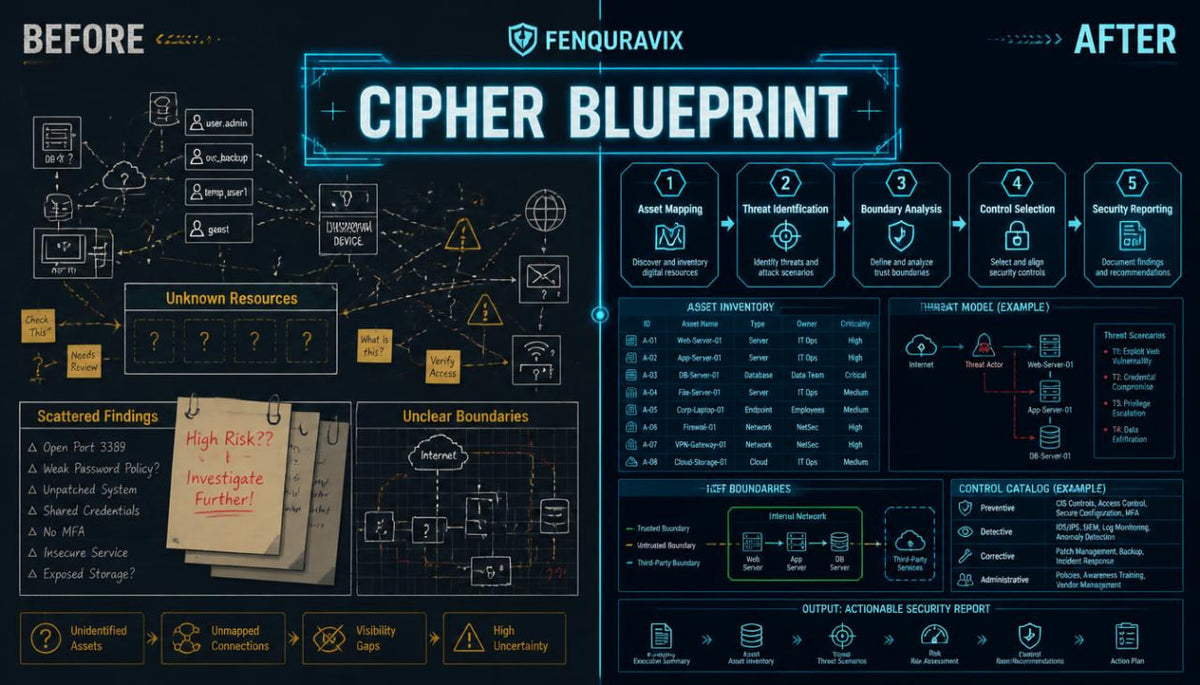
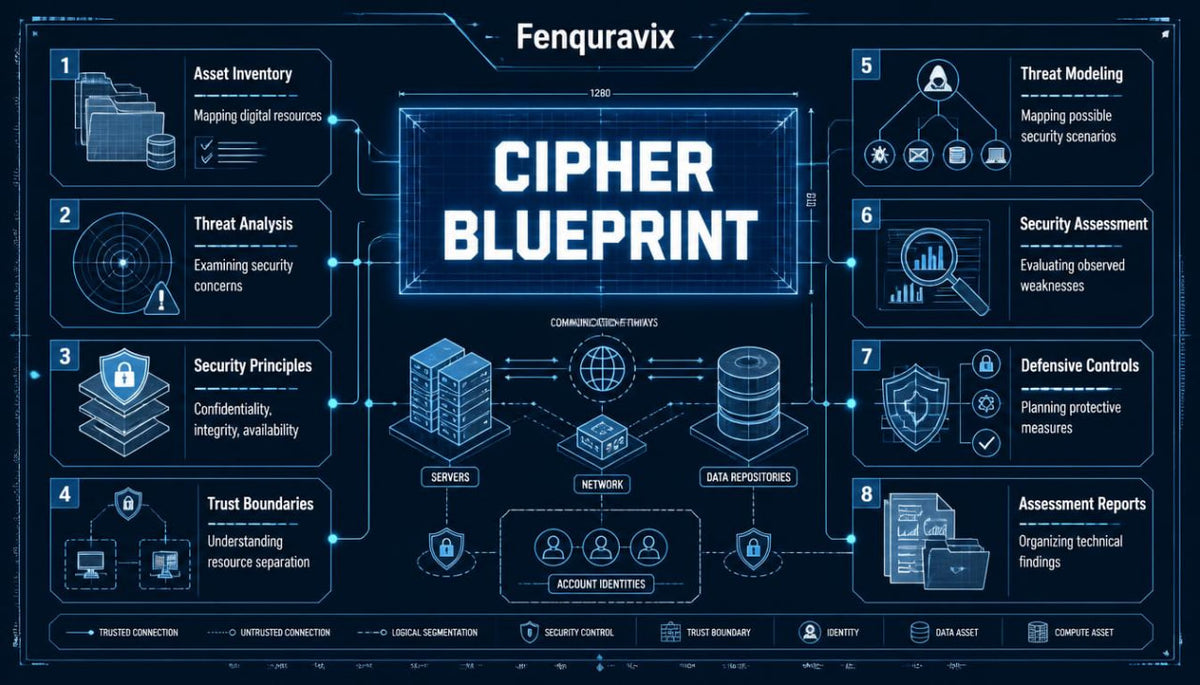
Cipher Blueprint introduces a structured approach to examining digital environments through asset identification, threat analysis, security principles, and defensive planning. The course guides learners through the reasoning behind common security decisions while explaining how individual protective measures fit into a broader security framework. Detailed examples illustrate how different vulnerabilities can affect information, connected resources, and routine digital activities. Practical worksheets and fictional scenarios encourage learners to document observations, compare possible responses, and develop organized security recommendations. The materials connect foundational knowledge with analytical activities that can be applied within authorized educational settings.
3. What's Inside
Module 01 — Mapping the Digital Environment
Cybersecurity planning begins with understanding what exists within a digital environment and how its components interact.
This module introduces the process of identifying digital resources, describing their functions, and examining the relationships between information, users, and connected components.
Learners explore different categories of digital assets, including stored records, communication pathways, account identities, and shared resources.
The material introduces the purpose of asset inventories and explains why accurate documentation supports security reviews.
Practical activity: Create a simplified asset inventory for a fictional organization, recording resource categories, general functions, and relevant security considerations.
Module 02 — Identifying Threats and Weaknesses
A threat does not always indicate that a security incident has occurred, and a vulnerability does not automatically mean that someone has exploited it.
This module examines these distinctions and introduces a structured vocabulary for discussing security concerns.
Learners explore technical weaknesses, inappropriate permissions, configuration errors, accidental disclosures, and human-related security issues.
The course explains how different weaknesses can interact and why their surrounding circumstances matter when evaluating them.
Practical activity: Review a collection of fictional security observations and classify each according to its threat category, possible weakness, and affected resource.
Module 03 — Information Security Principles
Information security involves protecting different characteristics of digital information rather than relying on a single defensive measure.
This module examines confidentiality, integrity, and availability in greater detail, using practical situations to illustrate their individual purposes.
Learners consider how unauthorized disclosure affects confidentiality, how unexpected modifications affect integrity, and how interruptions can affect availability.
The course also introduces the relationship between information classification and the selection of protective measures.
Practical activity: Analyze several fictional information-handling situations and identify which security principles are relevant to each example.
Module 04 — Understanding Security Boundaries
Digital environments frequently contain different groups of users, connected resources, and information categories.
This module introduces the concept of security boundaries and examines how separating responsibilities and resources can support defensive planning.
Learners study identity verification, permission assignment, role-based restrictions, and the principle of granting only the permissions required for an intended activity.
The material also considers why unnecessary permissions can create additional security concerns.
Practical activity: Examine a fictional organization with several user roles and prepare a permission matrix describing appropriate resource interactions.
Module 05 — Threat Modeling Fundamentals
Threat modeling provides a structured way to consider how unwanted events might affect digital resources.
This module introduces a conceptual threat-modeling process, beginning with identifying valuable information and understanding how that information moves between connected components.
Learners examine trust boundaries, entry points, possible weaknesses, and the relationship between security concerns and defensive responses.
The material focuses on analytical reasoning rather than conducting intrusive technical activities.
Practical activity: Create a simple data-flow diagram for a fictional information-sharing environment and identify areas that deserve additional security review.
Module 06 — Evaluating Security Concerns
Not every identified security issue requires the same response or level of attention.
This module explores introductory assessment methods for comparing security concerns based on their context, possible consequences, and likelihood.
Learners examine the difference between observed facts, reasonable assumptions, and information requiring further investigation.
The course also explains why security assessments should document uncertainty rather than presenting incomplete information as established fact.
Practical activity: Prepare a structured assessment worksheet for several fictional security concerns, including supporting observations and suggested review priorities.
Module 07 — Planning Defensive Measures
Identifying a security concern is followed by considering which defensive measures may be appropriate.
This module introduces preventive, detective, and corrective controls, explaining how each category contributes to security planning.
Learners examine authentication practices, permission reviews, information handling procedures, network separation, activity monitoring, and backup planning.
The material emphasizes that individual safeguards address different concerns and should be selected according to the environment being examined.
Practical activity: Match a set of fictional security findings with relevant protective measures and explain the reasoning behind each recommendation.
Module 08 — Documenting and Communicating Findings
Clear documentation is an important part of organized cybersecurity work.
This module explores how technical observations can be recorded and communicated without unnecessary complexity.
Learners study the structure of a basic security assessment summary, including an environment overview, identified concerns, supporting evidence, and suggested actions.
The materials explain how to distinguish factual observations from interpretations and recommendations.
Practical activity: Prepare a short security review document based on a fictional case study, organizing findings into clearly defined sections.
Final Workshop — The Digital Environment Review
The concluding workshop combines the concepts introduced throughout Cipher Blueprint.
Learners examine a fictional small organization containing shared documents, connected resources, different account roles, and several documented security concerns.
The workshop guides learners through preparing an asset inventory, identifying vulnerabilities, examining security boundaries, comparing concerns, and selecting appropriate defensive recommendations.
A concluding reflection section asks learners to explain the reasoning behind their decisions and identify areas requiring further information.
The workshop is intended as an educational exercise using fictional information rather than a real organizational assessment.
4. Who Is This For?
Cipher Blueprint is intended for learners who want to move beyond introductory cybersecurity terminology and begin studying how defensive security decisions are organized.
The course may be suitable for individuals with an interest in digital protection, students exploring information security, and independent learners who prefer structured analytical activities.
It is also relevant to readers who want to understand the purpose of threat modeling, resource inventories, security boundaries, and basic assessment documentation.
Some familiarity with introductory cybersecurity concepts may be helpful, although the materials explain the terminology used within each module.
The course focuses on defensive reasoning, educational scenarios, and documentation rather than intrusive technical testing.
5. What You'll Learn
Through the modules and practical activities, learners will explore how to:
- Identify and categorize common digital assets.
- Describe relationships between information, users, and connected resources.
- Distinguish threats, vulnerabilities, and observed incidents.
- Explain confidentiality, integrity, and availability.
- Recognize common security weaknesses within fictional environments.
- Prepare a basic digital asset inventory.
- Describe the purpose of identity verification and permission controls.
- Examine security boundaries and information pathways.
- Interpret simplified data-flow diagrams.
- Apply introductory threat-modeling concepts.
- Organize security observations into clear categories.
- Compare security concerns using documented assessment criteria.
- Distinguish preventive, detective, and corrective safeguards.
- Select reasonable defensive recommendations for fictional scenarios.
- Create a structured security review summary.
- Communicate technical observations using clear, factual language.
- Recognize when additional information is required before drawing conclusions.
- Apply responsible security reasoning within authorized educational environments.
6. Guarantee — 30-Day Refund Information
30-Day Money-Back Policy
Learners may submit a refund request within 30 days of purchase through the store's published contact channel.
Refund requests are reviewed according to the Refund Policy presented on the Fenquravix website, including the applicable eligibility conditions and any stated exceptions.
Learners should review those conditions before purchasing and retain their order details when submitting an inquiry.
Self-paced learning overview
- ⬇️ Digital file available after purchase
- ♾️ Long-term availability
- 🛡️ Secure checkout
- 🔄 Content updated in 2026
1. How are Fenquravix courses organized?
1. How are Fenquravix courses organized?
Each course follows a structured learning format with clearly defined topics, educational explanations, practical examples, and review activities. The materials are arranged to help learners study individual cybersecurity concepts and understand how they relate to broader digital security practices.
2. Do I need previous cybersecurity knowledge?
2. Do I need previous cybersecurity knowledge?
The recommended starting knowledge depends on the selected course. Introductory materials focus on foundational concepts, while subsequent courses examine more detailed technical subjects. Learners can review each course description to identify a suitable starting point.
3. Can I study the materials at my own pace?
3. Can I study the materials at my own pace?
Fenquravix courses are designed for independent study. Learners can read explanations, examine examples, revisit individual topics, and work through exercises according to their own study schedule.
Share