Fenquravix
Drift Framework
Drift Framework
Couldn't load pickup availability
1. Problem Statement
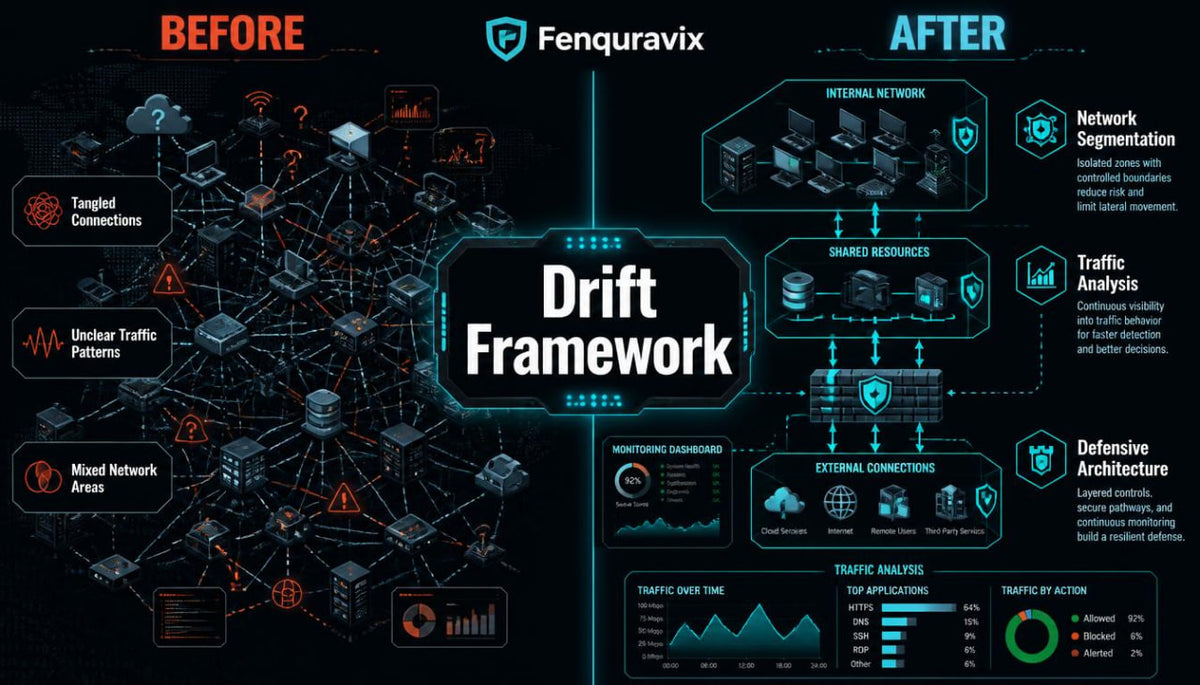
Modern digital environments rely on interconnected devices, communication channels, and shared resources that introduce different security considerations. Understanding individual network components does not always explain how information moves between them or where security weaknesses may develop. Learners may encounter difficulties interpreting network diagrams, recognizing unusual communication patterns, and understanding the purpose of different protective controls. Without a structured foundation in network defense, identifying relationships between communication activity, security boundaries, and protective measures can become confusing. A detailed examination of network behavior and defensive architecture helps learners develop a clearer understanding of how connected environments are organized and protected.
2. Solution
Drift Framework introduces network security through a structured sequence of technical explanations, illustrated examples, and analytical activities. The course examines communication pathways, network segmentation, traffic monitoring, and defensive architecture within fictional digital environments. Each module connects theoretical principles with practical exercises that encourage observation, documentation, and careful interpretation. Learners explore how protective measures can be selected and evaluated according to the structure and requirements of a particular environment. The course emphasizes responsible defensive analysis and the development of organized security documentation.
3. What's Inside
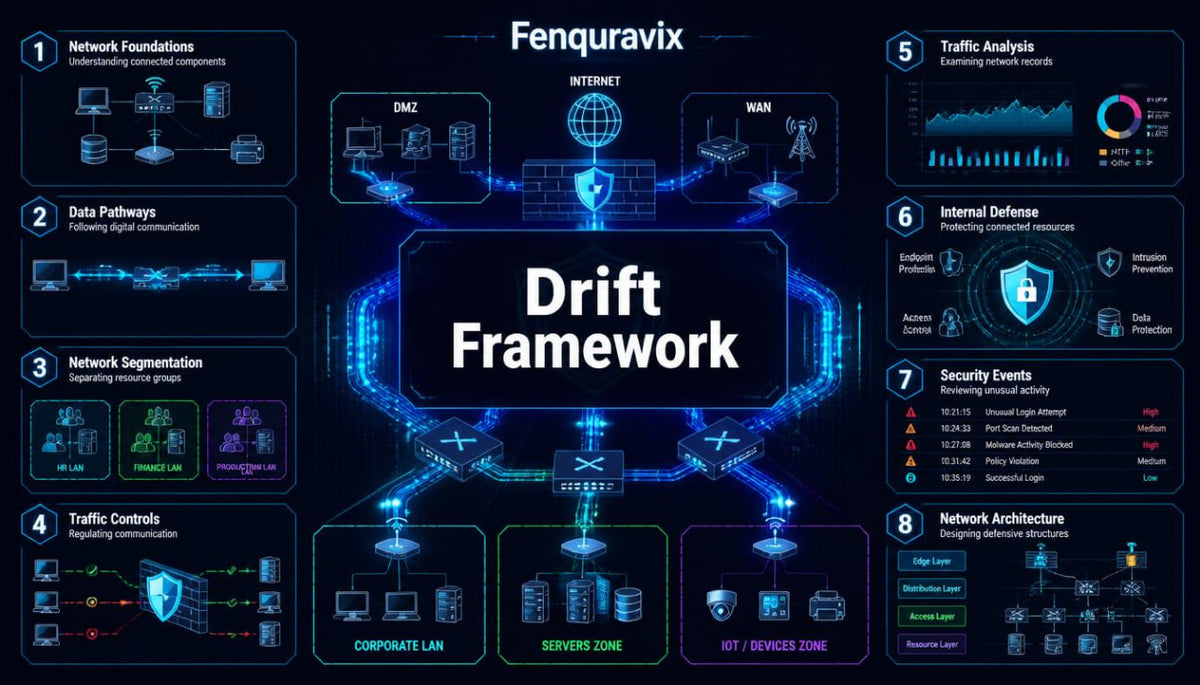
Module 01 — Beneath the Connection: Network Foundations
Connected environments depend on multiple components working together to exchange information.
This module establishes a technical foundation for understanding network communication and the security considerations associated with it.
Learners examine the relationships between endpoints, communication devices, network addresses, and information pathways.
The materials introduce the concept of layered communication and explain why different network functions require different defensive considerations.
Topics covered:
-
Network communication fundamentals.
-
Local and external communication pathways.
-
Network addressing concepts.
-
Communication protocols and their purposes.
-
Network components and their responsibilities.
-
Basic network diagrams.
-
Common network-security concerns.
Practical exercise: Examine a fictional network diagram and identify its primary components, communication relationships, and possible areas for security review.
Module 02 — Following the Data: Communication Pathways
Information does not simply appear at its destination; it travels through defined communication processes.
This module explores how information is organized for transmission and how network components participate in its movement.
Learners examine the purpose of data packets, communication sessions, routing decisions, and connection establishment.
The materials explain how ordinary communication behavior can be studied to understand the structure of a connected environment.
Special attention is given to distinguishing expected communication activity from situations requiring further examination.
Practical exercise: Review a simplified communication sequence and document the stages involved in transferring information between fictional network components.
Module 03 — Drawing the Boundaries: Network Segmentation
Network segmentation is a defensive approach that separates connected resources into defined groups.
This module examines why organizations may organize networks according to responsibilities, information sensitivity, and operational requirements.
Learners explore the relationship between network boundaries, communication restrictions, and the movement of information between separated areas.
The course introduces logical segmentation, controlled communication pathways, and the purpose of restricting unnecessary connections.
Topics covered:
-
Network segmentation principles.
-
Communication boundaries.
-
Resource grouping.
-
Internal and external network areas.
-
Traffic restrictions.
-
Segmentation documentation.
-
Defensive architecture considerations.
Practical exercise: Design a conceptual network layout for a fictional learning center containing administrative resources, student resources, and shared communication services.
Learners explain the reasoning behind each proposed separation.
Module 04 — The Defensive Perimeter: Traffic Control
Controlling network communication is an important element of defensive security planning.
This module introduces traffic-filtering principles and examines how communication rules can be used to regulate interactions between network components.
Learners study the purpose of network firewalls, filtering criteria, connection policies, and the distinction between permitted and restricted communication.
The materials also examine how poorly organized filtering arrangements may create security weaknesses or interrupt legitimate activities.
A dedicated section explores the importance of documenting communication requirements before preparing defensive rules.
Practical exercise: Analyze a fictional communication-policy table and identify entries that appear inconsistent with the stated network requirements.
Module 05 — Reading the Signals: Network Traffic Analysis
Network communication produces information that can be examined to understand activity within connected environments.
This module introduces the fundamentals of traffic analysis and the interpretation of network observations.
Learners examine simplified traffic records, connection patterns, communication frequency, and the relationship between network events.
The material explains how unusual communication behavior may indicate a technical problem, a configuration issue, or a possible security concern.
Learners also consider why context is necessary before treating an observation as suspicious.
Topics covered:
-
Network traffic characteristics.
-
Connection records.
-
Communication frequency.
-
Expected network behavior.
-
Unusual activity patterns.
-
Observation documentation.
-
Interpretation of incomplete information.
Practical exercise: Review a fictional traffic dataset and organize notable observations according to their characteristics and possible explanations.
Module 06 — Beyond the Perimeter: Internal Network Protection
Defensive security does not depend solely on controlling communication at external boundaries.
This module explores internal network protection and the importance of understanding communication between resources inside an organization.
Learners study internal segmentation, device responsibilities, shared resources, and the role of monitoring within connected environments.
The materials examine how unnecessary communication pathways and inconsistent protective arrangements may affect network security.
The module also introduces the relationship between account permissions and network-level restrictions.
Practical exercise: Evaluate a fictional internal network containing several departments and identify communication relationships that deserve additional review.
Module 07 — Recognizing Disruptions: Network Security Events
Network environments can experience unexpected communication activity, service interruptions, configuration problems, and suspected security incidents.
This module examines the distinction between ordinary technical faults and observations that may indicate a security concern.
Learners study basic event classification, incident indicators, network availability concerns, and the importance of maintaining clear records.
The materials introduce the purpose of escalation procedures and explain why observations should be communicated through appropriate organizational channels.
Practical exercise: Examine several fictional network-event summaries and prepare a classification report describing the available evidence and recommended review actions.
Module 08 — Designing a Connected Defense
This module brings together the technical concepts introduced throughout Drift Framework.
Learners examine how network structure, communication policies, segmentation, monitoring, and operational documentation can contribute to a coordinated defensive approach.
The materials introduce the relationship between security requirements and architectural decisions.
Learners consider how different controls address different concerns and why defensive planning should reflect the environment being examined.
A dedicated section explores the value of reviewing network diagrams, maintaining current documentation, and recording changes to communication requirements.
Practical exercise: Prepare a conceptual network-defense proposal for a fictional organization, including a network diagram, communication boundaries, monitoring considerations, and written explanations.
Final Workshop — The Network Observation Project
The final workshop presents a fictional organization with several connected departments, shared information resources, and documented network-security concerns.
Learners receive a simplified network diagram, a communication-policy summary, a sample traffic dataset, and several security observations.
Using these materials, learners complete a structured network review.
Workshop activities include:
-
Identifying network components and their responsibilities.
-
Mapping communication pathways between resources.
-
Examining existing network boundaries.
-
Reviewing fictional traffic-control arrangements.
-
Classifying unusual communication observations.
-
Identifying defensive considerations.
-
Preparing a written network-security review.
The concluding assignment brings these findings into a single report containing observations, explanations, and proposed defensive measures.
All workshop activities use fictional information and are intended for authorized educational study.
4. Who Is This For?
Drift Framework is intended for learners interested in understanding how connected digital environments operate and how network-security measures are organized.
The course may be suitable for individuals who have studied introductory cybersecurity principles and want to examine network-focused defensive concepts in greater detail.
It is also relevant to students interested in network architecture, information protection, traffic monitoring, and the interpretation of security observations.
Familiarity with basic cybersecurity terminology, account protection, and information-security principles is recommended.
The learning materials emphasize analytical reasoning, network documentation, and defensive planning rather than intrusive network activity.
5. What You'll Learn
Throughout Drift Framework, learners will explore how to:
- Explain the structure of common network environments.
- Identify different network components and their functions.
- Describe how information travels through communication pathways.
- Interpret simplified network diagrams.
- Explain the purpose of network addresses and communication protocols.
- Recognize common network-security concerns.
- Describe the principles of network segmentation.
- Identify communication boundaries within fictional environments.
- Explain the purpose of traffic-filtering controls.
- Interpret basic network communication policies.
- Review simplified traffic records.
- Distinguish ordinary communication patterns from unusual observations.
- Describe defensive monitoring principles.
- Recognize the importance of internal network protection.
- Classify fictional network-security events.
- Document technical observations using structured reporting methods.
- Compare defensive controls according to network requirements.
- Prepare conceptual network-security diagrams.
- Develop written recommendations for fictional network environments.
- Apply responsible defensive reasoning to network-security scenarios.
6. Refund Terms — 30-Day Policy
30-Day Refund Requests
Fenquravix provides a 30-day period for submitting refund requests concerning course purchases, subject to the eligibility conditions stated in the published Refund Policy.
Learners who wish to request a refund should contact the Fenquravix support team within 30 days of purchase and provide the relevant order information.
Each request is reviewed according to the applicable policy terms, including any stated conditions concerning digital educational materials.
Self-paced learning overview
- ⬇️ Digital file available after purchase
- ♾️ Long-term availability
- 🛡️ Secure checkout
- 🔄 Content updated in 2026
1. How are Fenquravix courses organized?
1. How are Fenquravix courses organized?
Each course follows a structured learning format with clearly defined topics, educational explanations, practical examples, and review activities. The materials are arranged to help learners study individual cybersecurity concepts and understand how they relate to broader digital security practices.
2. Do I need previous cybersecurity knowledge?
2. Do I need previous cybersecurity knowledge?
The recommended starting knowledge depends on the selected course. Introductory materials focus on foundational concepts, while subsequent courses examine more detailed technical subjects. Learners can review each course description to identify a suitable starting point.
3. Can I study the materials at my own pace?
3. Can I study the materials at my own pace?
Fenquravix courses are designed for independent study. Learners can read explanations, examine examples, revisit individual topics, and work through exercises according to their own study schedule.
Share