Fenquravix
Free Capsule
Free Capsule
Couldn't load pickup availability
1. Problem Statement
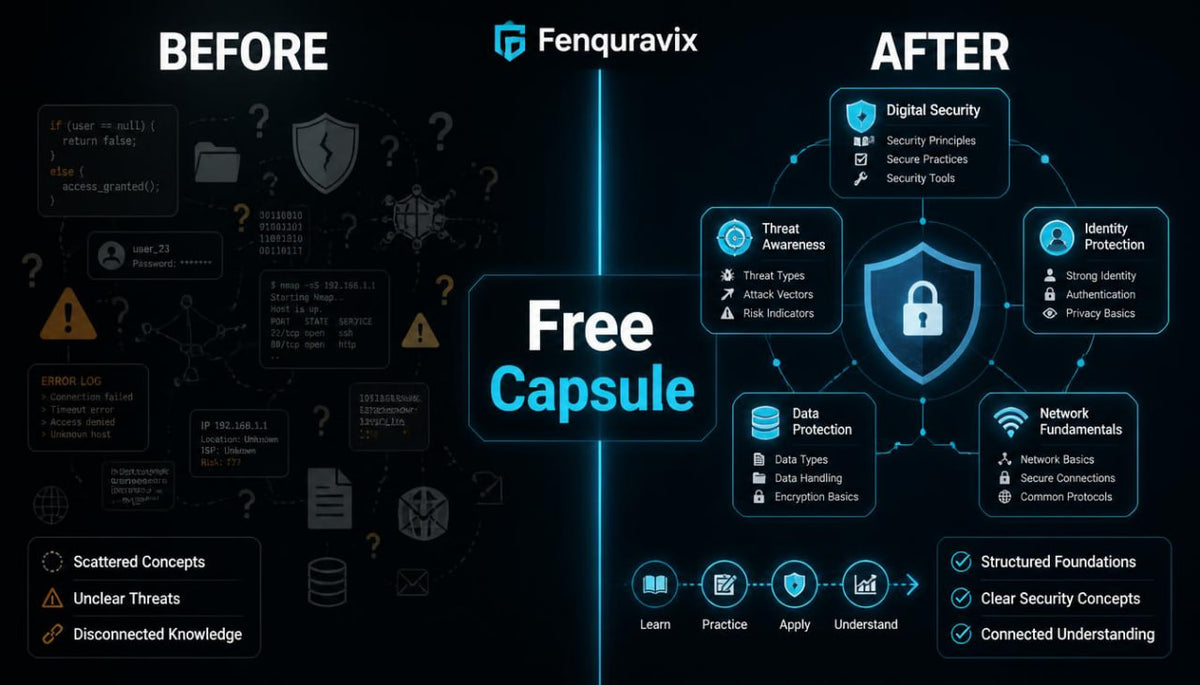
Digital environments are part of everyday communication, information storage, and countless routine activities, yet the security principles behind them are often difficult for newcomers to understand. Cybersecurity terminology can appear unfamiliar when concepts such as vulnerabilities, authentication, encryption, and digital threats are introduced without adequate context. Many introductory explanations describe individual security problems without showing how they relate to one another. This fragmented approach can make it difficult for learners to understand why particular security measures are used or how weaknesses develop. Without a clear foundation, interpreting security information and evaluating ordinary digital situations can become unnecessarily confusing.
2. Solution
Free Capsule presents cybersecurity as a connected collection of concepts that can be studied through observation, explanation, and practical reasoning. The course begins with fundamental terminology before introducing common threats, digital identity, information protection, and responsible security behavior. Each topic is presented through straightforward educational material supported by examples drawn from familiar digital situations. Guided activities encourage learners to examine security questions, identify relevant details, and consider appropriate defensive responses. By connecting individual subjects within a structured learning path, Free Capsule provides an introduction to the wider field of cybersecurity.
3. What's Inside
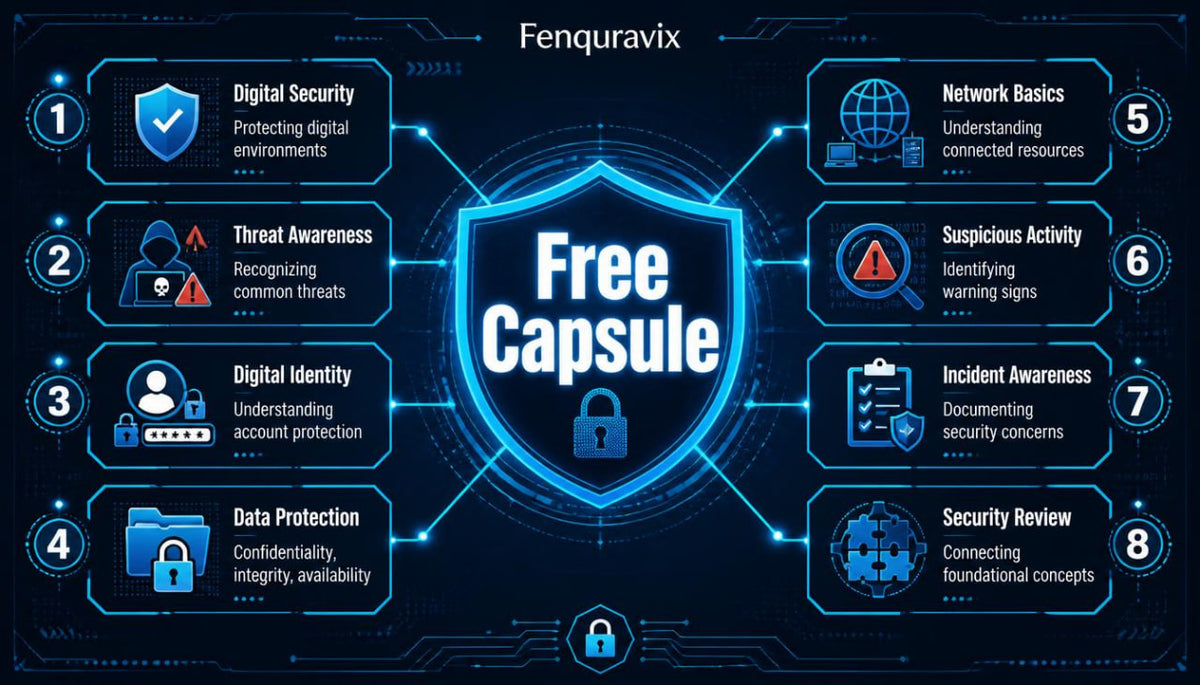
Module 01 — The Digital Security Landscape
The opening module introduces cybersecurity as a field concerned with protecting information, digital environments, and connected resources.
Learners examine the meaning of digital security and consider why protective measures matter in personal, educational, and organizational settings.
Topics include:
-
Understanding cybersecurity terminology.
-
The relationship between information, devices, and connected services.
-
Common categories of digital security concerns.
-
The roles of people, processes, and technical safeguards.
-
How everyday digital decisions can influence security.
A short reflection activity invites learners to identify situations where information protection plays a role in daily activities.
Module 02 — Understanding Digital Threats
This module explores how security problems can arise through technical weaknesses, human decisions, and unexpected events.
Rather than concentrating on complicated attack procedures, the material explains threat categories and the conditions that can make digital environments vulnerable.
Subjects include malicious files, deceptive messages, unsafe connections, unauthorized activity, and accidental information exposure.
Learners also explore the distinction between a threat, a vulnerability, and a security incident.
A classification exercise presents several fictional situations and asks learners to identify the relevant security concerns.
Module 03 — Digital Identity and Account Protection
Digital identity is closely connected to the way individuals interact with connected environments.
This module examines authentication, account permissions, credential handling, and common identity-related security concerns.
Learners study the purpose of strong authentication practices and consider why reusing account credentials can create additional exposure.
The material also introduces the principle of assigning permissions according to an individual's responsibilities.
A guided worksheet asks learners to examine fictional account settings and suggest improvements based on the concepts presented.
Module 04 — Information and Data Protection
Information can exist in many forms, including personal records, documents, communication histories, and organizational data.
This module examines why different categories of information require thoughtful handling and appropriate protective measures.
Learners are introduced to confidentiality, integrity, and availability as three foundational information-security principles.
Additional topics include information classification, secure storage practices, backups, and the role of encryption in protecting data.
An educational scenario explores a fictional team handling different types of records. Learners consider suitable storage, sharing, and retention practices for each category.
Module 05 — Connected Environments and Network Awareness
Connected devices exchange information through communication paths that may involve several components.
This module explains introductory networking concepts and their relationship to cybersecurity without requiring previous technical experience.
Learners explore the purpose of networks, communication boundaries, network devices, and basic protective controls.
The course also introduces the idea of separating different categories of connected resources to reduce unnecessary exposure.
A diagram-based exercise invites learners to examine a simplified network and identify areas where protective measures could be considered.
Module 06 — Recognizing Suspicious Digital Activity
Cybersecurity awareness involves examining information carefully rather than responding to unusual situations without context.
This module introduces common warning signs found in suspicious communications, unexpected account activity, and unfamiliar digital requests.
Learners consider the importance of verifying information through appropriate channels and avoiding unnecessary disclosure of sensitive details.
The module also discusses why unfamiliar attachments and unexpected requests deserve careful attention.
A scenario worksheet presents fictional examples and asks learners to distinguish ordinary activity from situations requiring further review.
Module 07 — Responding With a Security Mindset
The final learning module introduces fundamental incident-awareness concepts and responsible responses to suspected security concerns.
Learners examine why documenting observations, preserving relevant information, and following established reporting procedures can be valuable.
The materials distinguish between noticing suspicious activity, investigating a situation, and taking corrective action.
Special attention is given to staying within authorized activities and avoiding changes to unfamiliar environments.
A closing exercise asks learners to organize a simple response outline for a fictional security concern.
Course Review — Connecting the Concepts
The closing section brings together the terminology and ideas introduced across the modules.
Learners review short security situations involving information handling, identity protection, connected environments, and threat awareness.
Reflection questions encourage comparison between different protective measures and the circumstances in which they may be appropriate.
A final self-assessment provides an opportunity to revisit the course's central concepts and identify topics for further study.
4. Who Is This For?
Free Capsule is intended for people beginning their exploration of cybersecurity and digital protection.
It may be suitable for students, independent learners, individuals interested in technology, and anyone wishing to understand the reasoning behind common security practices.
The course does not require previous cybersecurity study, advanced technical knowledge, or specialized equipment.
Its introductory format emphasizes terminology, conceptual understanding, and observation rather than complicated technical procedures.
Learners who are considering further cybersecurity education can use the materials to become familiar with the subject areas covered in more detailed courses.
5. What You'll Learn
By working through Free Capsule, learners will explore how to:
- Explain the fundamental purpose of cybersecurity.
- Distinguish between threats, vulnerabilities, and incidents.
- Identify common categories of digital security concerns.
- Describe the role of authentication in account protection.
- Explain how permissions influence information security.
- Recognize the principles of confidentiality, integrity, and availability.
- Describe basic practices for handling sensitive information.
- Understand introductory network-security concepts.
- Examine suspicious communication scenarios.
- Identify circumstances requiring additional security review.
- Outline responsible incident-reporting steps.
- Apply foundational security reasoning to fictional situations.
- Connect individual cybersecurity topics within a broader defensive framework.
6. Guarantee — Enrollment and Refund Information
30-Day Money-Back Information
Free Capsule is provided without a course fee, so there is no payment to refund. A 30-day refund arrangement for other courses is governed by the published store refund policy and its applicable conditions.
Self-paced learning overview
- ⬇️ Digital file available after purchase
- ♾️ Long-term availability
- 🛡️ Secure checkout
- 🔄 Content updated in 2026
1. How are Fenquravix courses organized?
1. How are Fenquravix courses organized?
Each course follows a structured learning format with clearly defined topics, educational explanations, practical examples, and review activities. The materials are arranged to help learners study individual cybersecurity concepts and understand how they relate to broader digital security practices.
2. Do I need previous cybersecurity knowledge?
2. Do I need previous cybersecurity knowledge?
The recommended starting knowledge depends on the selected course. Introductory materials focus on foundational concepts, while subsequent courses examine more detailed technical subjects. Learners can review each course description to identify a suitable starting point.
3. Can I study the materials at my own pace?
3. Can I study the materials at my own pace?
Fenquravix courses are designed for independent study. Learners can read explanations, examine examples, revisit individual topics, and work through exercises according to their own study schedule.
Share