Fenquravix
Lattice Module
Lattice Module
Couldn't load pickup availability
1. Problem Statement
Digital environments generate continuous streams of activity records that may contain valuable information about operational conditions and security concerns. Identifying meaningful observations within these records can be challenging when events originate from different resources, accounts, and communication processes. Learners may understand individual security controls but lack a structured approach to examining recorded activity and distinguishing ordinary behavior from situations requiring attention. Without appropriate methods for organizing evidence and evaluating event relationships, important details may remain disconnected or be interpreted without sufficient context. Understanding security monitoring and event analysis provides a foundation for examining digital activity and developing informed defensive recommendations.
2. Solution
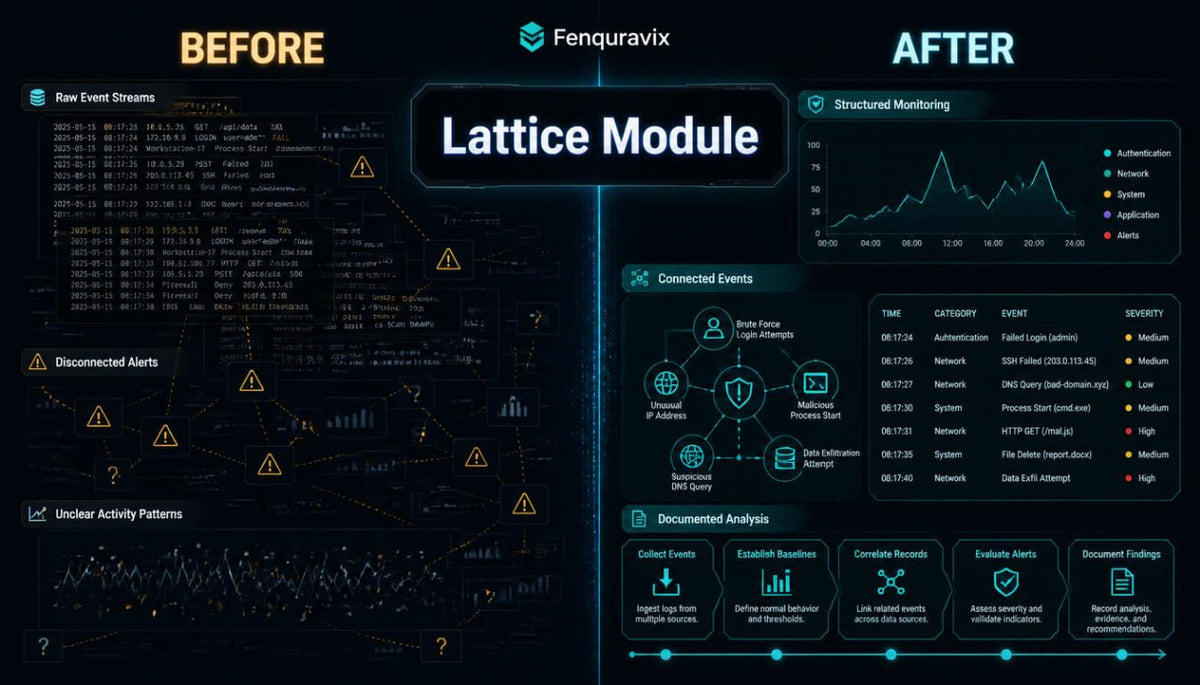
Lattice Module introduces security monitoring as an organized process involving event collection, observation, interpretation, and documentation. The course explains how different categories of security records can contribute to understanding digital activity and identifying possible concerns. Learners examine fictional event datasets, investigate relationships between observations, and explore methods for distinguishing expected activity from unusual patterns. Guided exercises introduce detection logic, alert classification, event timelines, and structured reporting practices. The materials emphasize evidence-based reasoning, responsible monitoring, and defensive analysis within authorized educational environments.
3. What's Inside
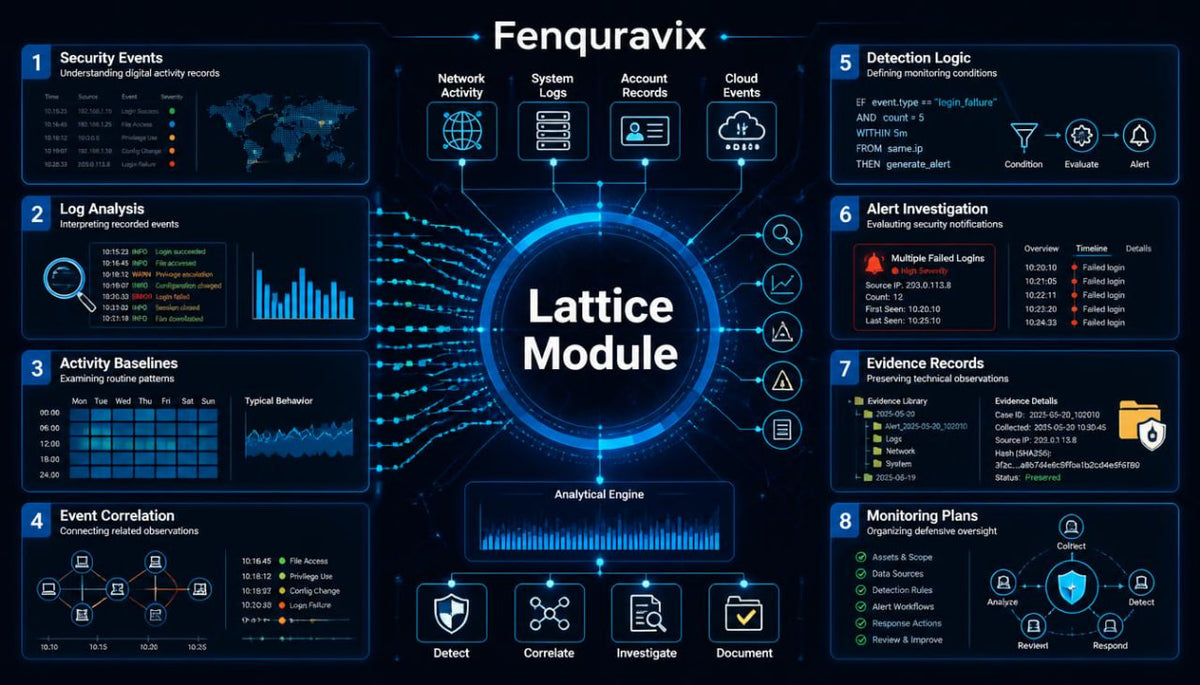
Module 01 — The Digital Footprint: Understanding Security Events
Digital activity leaves records that can provide information about interactions, configuration changes, and operational conditions.
This module introduces security events and examines how they relate to cybersecurity monitoring.
Learners investigate the differences between ordinary operational records, security observations, and events requiring further review.
Topics covered:
-
Security event fundamentals.
-
Types of digital activity records.
-
Event sources and their functions.
-
Recorded actions and associated metadata.
-
The relationship between events and security incidents.
-
Responsible interpretation of technical observations.
Practical exercise: Examine a fictional collection of activity records and categorize events according to their sources, purposes, and security relevance.
Module 02 — Behind the Records: Log Structures and Interpretation
Security logs organize information about activities taking place within digital environments.
This module examines common log structures and explains how recorded details can support technical analysis.
Learners study timestamps, event identifiers, source information, account references, action descriptions, and status indicators.
The materials also explain why incomplete records and inconsistent formatting can complicate interpretation.
Topics covered:
-
Log structure fundamentals.
-
Event timestamps and chronological order.
-
Recorded account and resource identifiers.
-
Activity descriptions.
-
Event status information.
-
Missing and inconsistent records.
Practical exercise: Review fictional log entries and identify the information needed to describe what occurred during a recorded activity.
Module 03 — Establishing Normal Activity Patterns
Recognizing unusual behavior requires an understanding of how an environment ordinarily operates.
This module introduces the concept of baseline activity and examines how patterns can be described using documented observations.
Learners explore recurring account activity, communication frequency, scheduled operations, and changes in resource behavior.
The course explains why unusual activity should be interpreted according to context rather than automatically classified as malicious.
Practical exercise: Examine a fictional activity dataset and document recurring patterns alongside observations that may require additional review.
Module 04 — Connecting the Signals: Event Correlation
Individual records may provide only a partial view of a security situation.
Event correlation involves examining relationships between observations to develop a more complete understanding of recorded activity.
This module explores how timestamps, account references, resource identifiers, and repeated actions can help connect related events.
Learners study the importance of chronological consistency and the difference between a meaningful relationship and an unsupported assumption.
Practical exercise: Organize a collection of fictional security events into a timeline and identify observations that may share a common context.
Module 05 — Detection Logic and Alert Evaluation
Security monitoring often involves defining conditions that indicate when recorded activity deserves further examination.
This module introduces basic detection logic and explains how monitoring criteria relate to observed events.
Learners explore event thresholds, repeated actions, unusual activity sequences, and the relationship between detection conditions and alert generation.
The materials also introduce false positives and false negatives, explaining why detection results require careful interpretation.
Topics covered:
-
Detection rule fundamentals.
-
Event conditions and thresholds.
-
Alert generation principles.
-
False-positive observations.
-
Missed activity considerations.
-
Documenting detection criteria.
Practical exercise: Examine fictional detection rules and compare their behavior against a prepared collection of event records.
Module 06 — Security Alerts and Initial Investigation
An alert indicates that a defined condition has been observed, but it does not independently establish that a security incident occurred.
This module explores alert classification and initial investigative reasoning.
Learners examine how event context, supporting records, affected resources, and available evidence contribute to understanding an alert.
The course discusses the importance of recording uncertainty and following established procedures when additional investigation is required.
Practical exercise: Evaluate several fictional monitoring alerts and prepare short explanations describing the observations, supporting details, and recommended review actions.
Module 07 — Preserving Evidence and Recording Observations
Security analysis depends on maintaining reliable information about what was observed.
This module introduces evidence-handling principles, documentation methods, and the importance of preserving the original context of recorded events.
Learners examine the relationship between event timelines, supporting records, investigation notes, and technical conclusions.
The materials also discuss privacy considerations and the responsible handling of sensitive information during security reviews.
Practical exercise: Prepare an evidence summary for a fictional security event, separating documented facts from interpretations and outstanding questions.
Module 08 — From Monitoring to Defensive Planning
Security monitoring becomes more informative when findings contribute to the review of existing protective measures.
This module examines how recorded observations can support defensive planning, configuration reviews, and the development of monitoring recommendations.
Learners study the relationship between event detection, reporting procedures, and organizational security responsibilities.
The materials explain why monitoring arrangements should reflect the environment's operational requirements and information-handling responsibilities.
Practical exercise: Develop a conceptual monitoring plan for a fictional organization, describing relevant event categories, review criteria, and documentation procedures.
Final Workshop — The Security Event Investigation
The concluding workshop combines event interpretation, correlation, alert evaluation, and defensive reporting.
Learners receive a fictional organizational scenario containing account activity records, network observations, monitoring alerts, and documented security concerns.
Workshop activities include:
-
Identifying relevant security event sources.
-
Organizing event records chronologically.
-
Examining ordinary activity patterns.
-
Connecting related security observations.
-
Reviewing fictional alert conditions.
-
Distinguishing confirmed findings from assumptions.
-
Preparing an event investigation summary.
-
Developing defensive monitoring recommendations.
The final assignment requires learners to produce a structured report containing an event timeline, supporting evidence, analytical observations, and recommendations for further review.
All activities use fictional datasets and are intended for authorized educational study.
4. Who Is This For?
Lattice Module is intended for learners interested in cybersecurity monitoring, security event analysis, and defensive investigation methods.
The course may be suitable for students who have studied foundational cybersecurity principles and want to explore how recorded digital activity can be interpreted.
It is also relevant to individuals interested in security operations, incident documentation, event correlation, and the reasoning behind detection methods.
Previous familiarity with network-security concepts, digital identities, vulnerability categories, and defensive controls is recommended.
The materials focus on interpreting observations, documenting evidence, and developing defensive recommendations rather than conducting unauthorized investigations.
5. What You'll Learn
Throughout Lattice Module, learners will explore how to:
- Explain the purpose of cybersecurity monitoring.
- Identify common categories of security event records.
- Interpret fundamental log structures.
- Recognize timestamps, event identifiers, and activity descriptions.
- Organize recorded events into chronological sequences.
- Describe ordinary digital activity patterns.
- Identify observations requiring additional review.
- Explain introductory event-correlation principles.
- Connect related records using documented information.
- Describe the purpose of security detection rules.
- Interpret fictional alert conditions.
- Distinguish false-positive observations from confirmed findings.
- Evaluate security alerts using contextual evidence.
- Prepare structured event investigation timelines.
- Explain responsible evidence-handling principles.
- Document technical findings without unsupported conclusions.
- Describe the relationship between monitoring and defensive controls.
- Create conceptual security monitoring plans.
- Prepare organized event investigation reports.
- Apply defensive analytical reasoning to fictional security scenarios.
6. Refund Information — 30-Day Policy
30-Day Refund Requests
Fenquravix provides a 30-day period for submitting refund requests concerning course purchases, subject to the eligibility requirements described in the published Refund Policy.
Learners wishing to submit a refund request should contact the Fenquravix support team within 30 days of purchase and provide their relevant order information.
Requests are reviewed according to the applicable policy conditions, including any provisions concerning digital educational materials.
Self-paced learning overview
- ⬇️ Digital file available after purchase
- ♾️ Long-term availability
- 🛡️ Secure checkout
- 🔄 Content updated in 2026
1. How are Fenquravix courses organized?
1. How are Fenquravix courses organized?
Each course follows a structured learning format with clearly defined topics, educational explanations, practical examples, and review activities. The materials are arranged to help learners study individual cybersecurity concepts and understand how they relate to broader digital security practices.
2. Do I need previous cybersecurity knowledge?
2. Do I need previous cybersecurity knowledge?
The recommended starting knowledge depends on the selected course. Introductory materials focus on foundational concepts, while subsequent courses examine more detailed technical subjects. Learners can review each course description to identify a suitable starting point.
3. Can I study the materials at my own pace?
3. Can I study the materials at my own pace?
Fenquravix courses are designed for independent study. Learners can read explanations, examine examples, revisit individual topics, and work through exercises according to their own study schedule.
Share