Fenquravix
Slate Edition
Slate Edition
Couldn't load pickup availability
1. Problem Statement
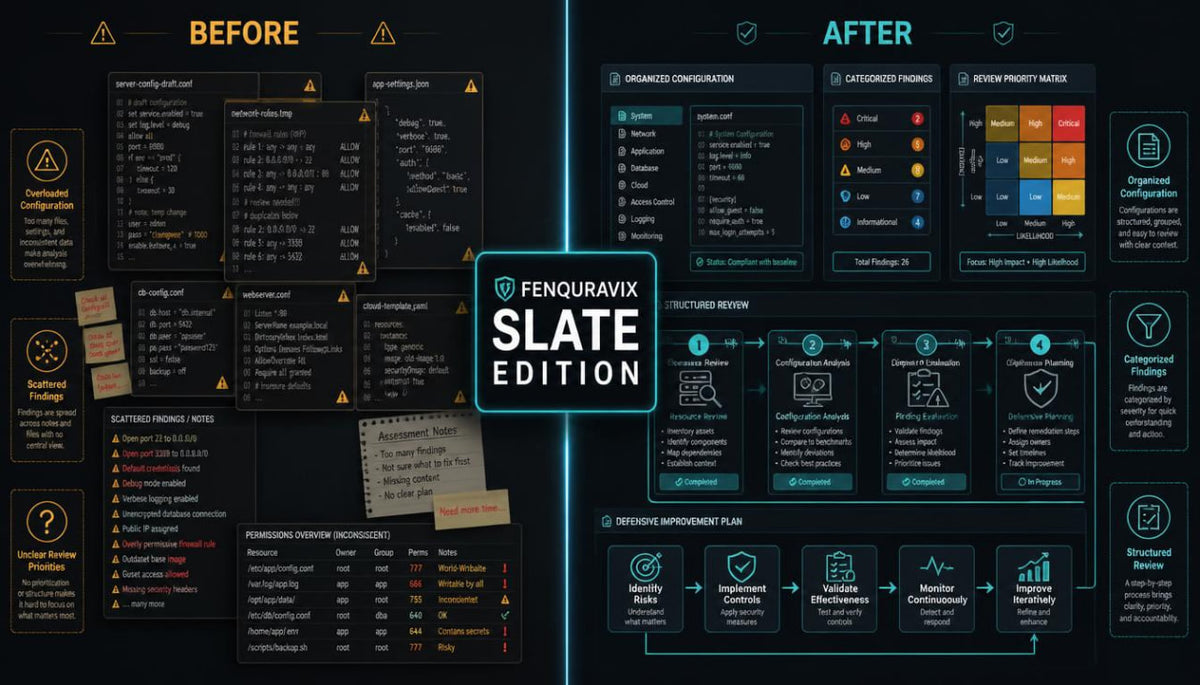
Digital environments contain numerous components, configurations, and interconnected resources that may introduce security weaknesses when they are not reviewed regularly. Identifying a vulnerability is only one part of cybersecurity analysis, as understanding its context, possible consequences, and relationship to existing safeguards is equally important. Learners may struggle to distinguish between configuration weaknesses, outdated components, unnecessary permissions, and observations that require further investigation. Without a structured evaluation process, security findings can become difficult to organize, compare, and communicate. Developing an understanding of vulnerability assessment and defensive planning provides a foundation for examining security conditions and preparing appropriate protective recommendations.
2. Solution
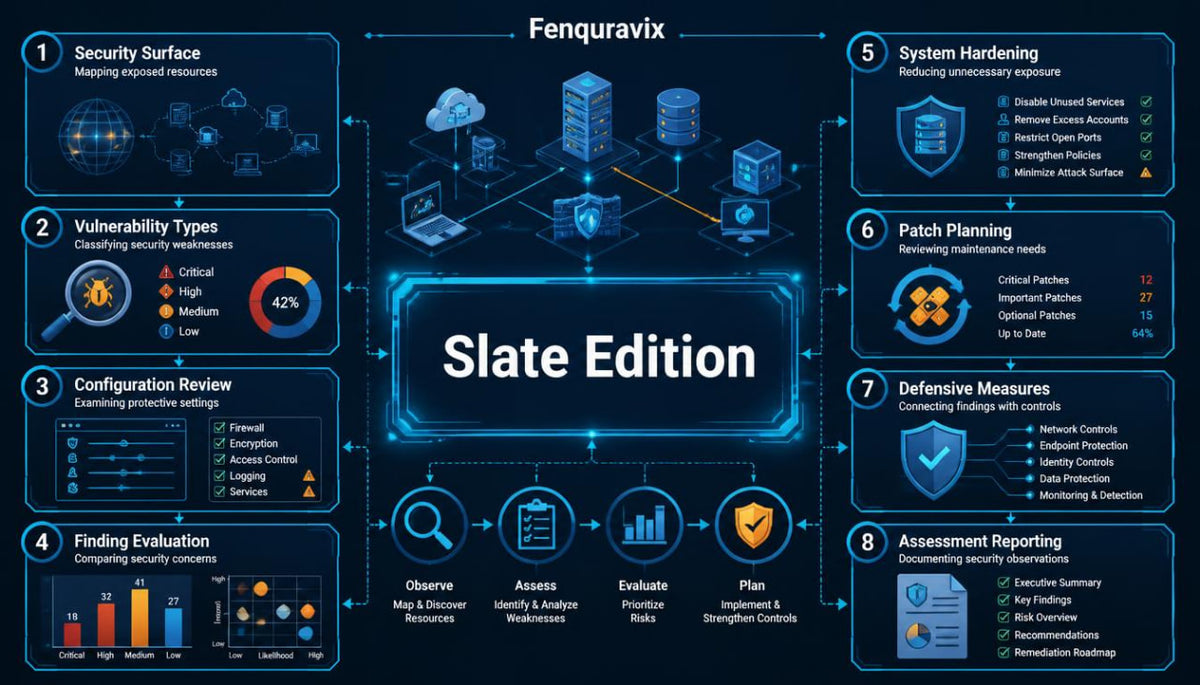
Slate Edition introduces a systematic approach to vulnerability evaluation, security configuration, and defensive improvement planning. The course examines how weaknesses arise, how their significance can be assessed, and how security controls relate to different technical environments. Each module combines conceptual explanations with fictional scenarios and guided activities that encourage careful observation and documentation. Learners explore how remediation priorities can be established using contextual information, operational requirements, and clearly documented assessment criteria. The materials emphasize responsible cybersecurity analysis, organized reporting, and the evaluation of defensive measures within authorized learning environments.
3. What's Inside
Module 01 — Reading the Security Surface
Every digital environment contains components whose configuration and operation influence its overall security condition.
This module introduces the concept of an attack surface from a defensive perspective, examining the resources, interfaces, communication pathways, and permissions that require security consideration.
Learners study how connected components create relationships that should be documented during a security review.
Topics covered:
-
Understanding the digital attack surface.
-
Resource inventories and component identification.
-
Security boundaries and exposed services.
-
Configuration documentation.
-
Internal and external security considerations.
-
Identifying areas requiring further review.
Practical exercise: Prepare a security-surface inventory for a fictional organization and classify its components according to their functions and defensive requirements.
Module 02 — Understanding Vulnerability Categories
Security weaknesses can emerge from different technical and organizational conditions.
This module examines vulnerability categories, including outdated components, inappropriate configurations, unnecessary privileges, insufficient monitoring, and weaknesses in information-handling procedures.
Learners investigate how vulnerabilities differ from threats and why a vulnerability does not automatically indicate an active security incident.
The materials also introduce the distinction between confirmed findings, suspected weaknesses, and incomplete observations.
Practical exercise: Analyze fictional vulnerability reports and classify the described weaknesses according to their characteristics and affected resources.
Module 03 — Configuration Under Examination
Security configuration determines how digital components behave, communicate, and interact with information.
This module introduces configuration review principles and explains how inappropriate settings may influence a digital environment's security condition.
Learners examine account restrictions, communication rules, resource permissions, activity recording, and protective configuration practices.
The course discusses how configuration requirements can vary according to operational responsibilities.
Topics covered:
-
Security configuration principles.
-
Configuration baselines.
-
Permission and identity settings.
-
Communication restrictions.
-
Activity recording requirements.
-
Documentation of configuration changes.
Practical exercise: Review a fictional configuration checklist and identify settings that deserve additional examination.
Module 04 — Evaluating Vulnerability Significance
Different security weaknesses may have different consequences depending on the affected environment.
This module introduces contextual vulnerability assessment, examining how asset importance, exposure, possible impact, and existing safeguards contribute to an evaluation.
Learners study why numerical severity ratings should be interpreted alongside environmental information rather than considered in isolation.
The materials also discuss the importance of distinguishing factual evidence from assumptions.
Practical exercise: Compare several fictional security findings and prepare an evaluation table explaining their relative significance.
Module 05 — Defensive Configuration and System Hardening
System hardening involves reducing unnecessary functionality and organizing protective settings according to defined security requirements.
This module explores the reasoning behind defensive configuration practices, including reducing unnecessary services, reviewing permissions, organizing communication restrictions, and maintaining relevant protective settings.
Learners examine the relationship between operational needs and security decisions.
The materials discuss why configuration changes require documentation, review, and consideration of their possible effects on ordinary activities.
Practical exercise: Develop a defensive configuration checklist for a fictional information-management environment.
Module 06 — Updates, Patches, and Change Planning
Digital components may require maintenance when weaknesses are discovered or operational requirements change.
This module examines the purpose of security updates, patch evaluation, maintenance schedules, and documented change procedures.
Learners explore why updates should be considered alongside compatibility, operational requirements, and available information about identified weaknesses.
The course introduces the importance of recording maintenance decisions and verifying observed conditions after authorized changes.
Practical exercise: Examine a fictional maintenance register and propose an organized review schedule based on documented security concerns.
Module 07 — Connecting Findings With Defensive Controls
A vulnerability assessment becomes more informative when individual findings are connected with relevant defensive considerations.
This module examines how protective controls can be selected according to the nature of a weakness and the environment in which it appears.
Learners compare preventive, detective, and corrective measures, considering their purposes and practical limitations.
The materials emphasize documenting the reasoning behind recommendations rather than treating one measure as suitable for every situation.
Practical exercise: Match fictional vulnerability findings with possible defensive measures and explain the relationship between each finding and recommendation.
Module 08 — Writing a Structured Security Assessment
Technical findings require clear documentation so that readers can understand the observations and proposed actions.
This module introduces the structure of a vulnerability assessment report.
Learners examine how to describe affected resources, observation methods, supporting evidence, possible consequences, and remediation considerations.
The course also discusses communicating uncertainty and identifying information that requires further investigation.
Practical exercise: Prepare a fictional assessment report containing an environment overview, categorized findings, evaluation notes, and defensive recommendations.
Final Workshop — The Security Baseline Review
The concluding workshop combines vulnerability evaluation, configuration analysis, and remediation planning within one fictional organizational scenario.
Learners receive an environment inventory, configuration summaries, vulnerability observations, and maintenance records.
Workshop activities:
-
Review the documented environment.
-
Identify resources requiring security consideration.
-
Classify configuration weaknesses.
-
Examine reported vulnerabilities.
-
Compare findings using contextual criteria.
-
Identify relevant defensive measures.
-
Prepare a remediation review schedule.
-
Produce a structured security assessment report.
The final assignment encourages learners to explain their findings, describe their reasoning, and distinguish confirmed observations from matters requiring further examination.
All activities use fictional materials and are intended for authorized educational study.
4. Who Is This For?
Slate Edition is intended for learners who want to explore vulnerability management and defensive configuration practices in greater detail.
The course may be suitable for students familiar with introductory cybersecurity principles, individuals interested in security assessments, and independent learners studying technical protection methods.
It is particularly relevant to those interested in understanding how security weaknesses are documented, evaluated, and connected with defensive recommendations.
Previous familiarity with digital assets, network-security concepts, identity protection, and information-security principles is recommended.
The educational materials concentrate on defensive analysis, documentation, and responsible configuration review rather than unauthorized testing.
5. What You'll Learn
Throughout Slate Edition, learners will explore how to:
-
Describe the purpose of vulnerability assessment.
-
Identify common categories of security weaknesses.
-
Explain the relationship between vulnerabilities, threats, and security incidents.
-
Examine the defensive significance of exposed resources.
-
Prepare a structured security-surface inventory.
-
Interpret fictional configuration records.
-
Describe the purpose of security baselines.
-
Identify inappropriate permission arrangements.
-
Explain fundamental system-hardening principles.
-
Recognize unnecessary services and communication pathways.
-
Evaluate security findings using contextual criteria.
-
Distinguish confirmed observations from assumptions.
-
Explain the purpose of security updates and patch planning.
-
Describe the role of change documentation.
-
Compare preventive, detective, and corrective safeguards.
-
Organize vulnerability findings by review priority.
-
Prepare defensive configuration checklists.
-
Connect security weaknesses with remediation considerations.
-
Document technical observations in assessment reports.
-
Develop a structured remediation review plan.
-
Apply responsible cybersecurity reasoning to fictional organizational scenarios.
6. Refund Information — 30-Day Policy
30-Day Money-Back Terms
Fenquravix provides a 30-day period for submitting refund requests concerning course purchases, subject to the eligibility requirements stated in the published Refund Policy.
Learners who wish to request a refund should contact the Fenquravix support team within 30 days of purchase and provide their relevant order information.
Refund eligibility and processing are determined by the published policy conditions, including any applicable provisions concerning digital educational materials.
Self-paced learning overview
- ⬇️ Digital file available after purchase
- ♾️ Long-term availability
- 🛡️ Secure checkout
- 🔄 Content updated in 2026
1. How are Fenquravix courses organized?
1. How are Fenquravix courses organized?
Each course follows a structured learning format with clearly defined topics, educational explanations, practical examples, and review activities. The materials are arranged to help learners study individual cybersecurity concepts and understand how they relate to broader digital security practices.
2. Do I need previous cybersecurity knowledge?
2. Do I need previous cybersecurity knowledge?
The recommended starting knowledge depends on the selected course. Introductory materials focus on foundational concepts, while subsequent courses examine more detailed technical subjects. Learners can review each course description to identify a suitable starting point.
3. Can I study the materials at my own pace?
3. Can I study the materials at my own pace?
Fenquravix courses are designed for independent study. Learners can read explanations, examine examples, revisit individual topics, and work through exercises according to their own study schedule.
Share