Fenquravix
Trail Series
Trail Series
Couldn't load pickup availability
1. Problem Statement
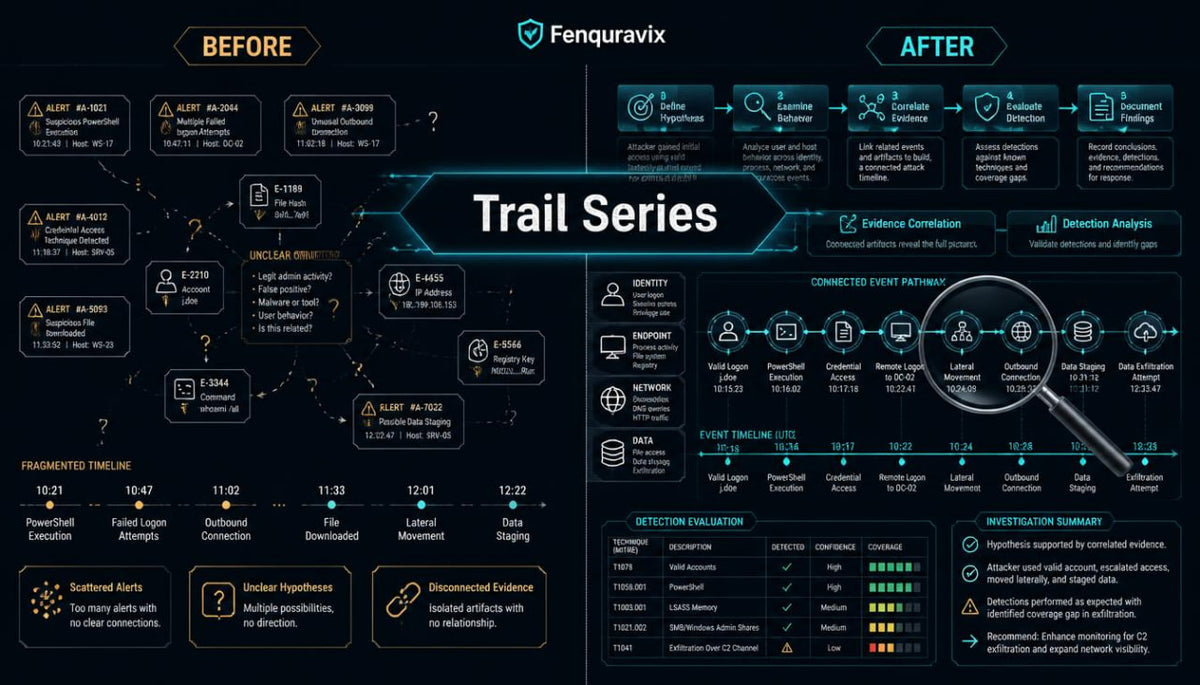
Complex digital environments generate large quantities of security information, making it challenging to distinguish routine activity from meaningful indicators of suspicious behavior. Individual alerts may reveal isolated observations without explaining the wider sequence of events or the relationships between affected resources. Learners who are familiar with basic monitoring concepts may still find it difficult to formulate investigation hypotheses, examine multiple evidence sources, and evaluate detection criteria. Incomplete records, inconsistent timestamps, and overlapping event patterns can further complicate the interpretation of security activity. Developing structured investigative methods helps learners examine these challenges through careful analysis, documented reasoning, and coordinated defensive practices.
2. Solution
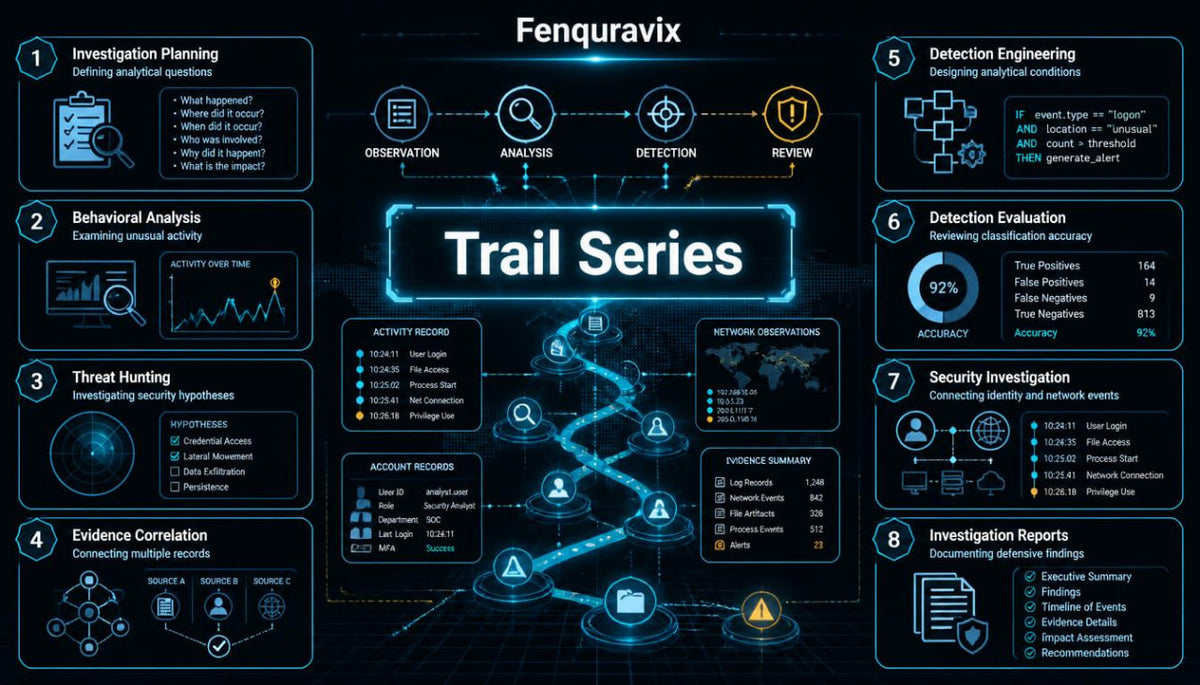
Trail Series introduces an investigative approach to cybersecurity that connects threat hunting, event correlation, detection design, and defensive analysis. The course guides learners through the process of developing investigation questions, collecting relevant observations, and examining evidence within fictional security environments. Detailed learning scenarios demonstrate how different activity records can contribute to a broader understanding of potentially suspicious events. Practical assignments encourage learners to evaluate detection methods, compare interpretations, and prepare structured investigation reports. The materials emphasize analytical discipline, responsible security research, and defensive decision-making based on documented evidence.
3. What's Inside
Module 01 — Beyond the Alert: Investigative Security Thinking
Security investigations frequently begin with incomplete information that requires careful interpretation.
This module introduces investigative thinking and examines how analysts can develop structured questions about unusual digital activity.
Learners explore the relationship between observations, assumptions, investigation hypotheses, and documented conclusions.
Topics covered:
-
Investigative reasoning in cybersecurity.
-
Security observations and supporting evidence.
-
Developing investigation hypotheses.
-
Identifying relevant information sources.
-
Distinguishing facts from interpretations.
-
Recording analytical uncertainty.
-
Structuring investigative questions.
Practical exercise: Review a fictional collection of security observations and formulate investigation questions supported by the available information.
Module 02 — Understanding Behavioral Threat Patterns
Suspicious activity can involve sequences of actions that appear ordinary when examined individually.
This module explores behavioral analysis and examines how relationships between events can provide additional investigative context.
Learners study repeated account activity, unusual resource interactions, unexpected communication patterns, and changes in documented behavior.
The materials explain why behavioral observations require contextual analysis rather than immediate assumptions about malicious intent.
Topics covered:
-
Behavioral security analysis.
-
Expected activity patterns.
-
Unusual event sequences.
-
Account behavior observations.
-
Resource interaction patterns.
-
Relationships between technical events.
Practical exercise: Examine fictional activity records and identify behavioral patterns that deserve additional investigation.
Module 03 — Forming a Threat Hunting Hypothesis
Threat hunting is a structured defensive investigation process that examines activity for indications of possible security concerns.
This module introduces hypothesis-driven threat hunting and explains how investigation questions can guide the review of available evidence.
Learners study how to define an investigation scope, identify relevant event categories, and establish criteria for evaluating observations.
The materials also examine how investigators can document uncertainty and refine hypotheses when new information becomes available.
Practical exercise: Develop a fictional threat hunting plan containing an investigation question, relevant evidence sources, analytical criteria, and documentation requirements.
Module 04 — Connecting Dispersed Security Evidence
Security information may originate from different components, accounts, communication pathways, and monitoring records.
This module examines how evidence from multiple sources can be organized into a connected investigative narrative.
Learners explore timestamp alignment, event relationships, activity sequences, and the interpretation of incomplete records.
The course discusses how inconsistent information can affect analytical conclusions and why alternative explanations should be considered.
Topics covered:
-
Multi-source event correlation.
-
Chronological evidence organization.
-
Relationships between account and network events.
-
Evidence consistency.
-
Missing information.
-
Alternative interpretations.
-
Investigation timeline development.
Practical exercise: Construct an investigation timeline from fictional records containing account observations, network events, and monitoring notifications.
Module 05 — Engineering Detection Logic
Defensive detection methods rely on clearly defined criteria that identify activity requiring examination.
This module introduces detection engineering as the process of designing, reviewing, and refining analytical conditions.
Learners examine how event characteristics can be organized into detection criteria and how those criteria relate to specific security concerns.
The materials discuss detection sensitivity, alert relevance, false positives, and the importance of documenting rule behavior.
Practical exercise: Prepare conceptual detection conditions for several fictional security scenarios and examine how those conditions classify sample event records.
Module 06 — Examining Detection Quality
A detection method can identify certain event patterns while overlooking others or reporting ordinary behavior as suspicious.
This module explores how defensive detection criteria can be evaluated using prepared educational datasets.
Learners examine the relationship between detection conditions, event context, and classification results.
The course introduces structured review methods for identifying inconsistent detection behavior and proposing improvements.
Topics covered:
-
Detection evaluation principles.
-
Expected detection behavior.
-
False-positive classifications.
-
False-negative considerations.
-
Reviewing detection thresholds.
-
Comparing analytical criteria.
-
Documenting detection revisions.
Practical exercise: Evaluate fictional detection conditions against a labeled dataset and prepare recommendations describing possible refinements.
Module 07 — Investigating Identity and Network Activity
Identity-related observations and network communication records can provide complementary information during defensive investigations.
This module examines how account events, permission changes, communication patterns, and resource interactions can be studied together.
Learners consider how activity involving several components may be connected through timestamps, identifiers, and documented relationships.
The materials also discuss the importance of respecting investigation boundaries and handling sensitive information responsibly.
Practical exercise: Analyze a fictional scenario involving unusual account behavior and network observations, then prepare an evidence-based investigation summary.
Module 08 — From Findings to Defensive Recommendations
An investigation report should explain not only what was observed but also why the findings matter within the examined environment.
This module explores how technical findings can inform defensive monitoring, configuration reviews, permission assessments, and incident-response planning.
Learners study the relationship between investigative conclusions and practical security recommendations.
The materials emphasize distinguishing actions supported by documented evidence from suggestions that require additional evaluation.
Practical exercise: Prepare a defensive recommendation document based on a fictional investigation, including supporting observations and unresolved questions.
Module 09 — Communicating Complex Investigations
Detailed investigations can contain numerous events, conflicting observations, and technical explanations.
This module introduces methods for communicating analytical findings in a clear and organized manner.
Learners examine investigation report structures, evidence references, timeline summaries, technical explanations, and review conclusions.
The course also discusses how different audiences may require different levels of technical detail.
Practical exercise: Convert a fictional set of technical investigation notes into a structured report containing an overview, evidence timeline, analytical findings, and proposed defensive actions.
Final Workshop — The Threat Hunting Investigation
The concluding workshop combines hypothesis development, behavioral analysis, evidence correlation, detection evaluation, and structured reporting.
Learners receive a fictional organizational environment containing network communication records, account activity observations, monitoring alerts, and several unresolved security concerns.
Workshop activities include:
-
Reviewing the documented environment and investigation boundaries.
-
Developing an initial threat hunting hypothesis.
-
Identifying relevant evidence sources.
-
Examining unusual account and communication patterns.
-
Organizing related events into an investigation timeline.
-
Evaluating fictional detection criteria.
-
Comparing alternative explanations for recorded activity.
-
Documenting findings and unresolved questions.
-
Preparing defensive recommendations.
-
Producing a complete investigation report.
The final assignment combines the investigation stages into one documented case study, encouraging learners to demonstrate the reasoning behind their analytical decisions.
All workshop activities use fictional datasets and are intended for authorized educational study.
4. Who Is This For?
Trail Series is intended for learners who want to examine advanced cybersecurity investigation techniques and the analytical principles behind threat hunting.
The course may be suitable for students who have already explored security monitoring, vulnerability assessment, network defense, and incident-response concepts.
It is also relevant to individuals interested in detection engineering, event correlation, behavioral security analysis, and investigative documentation.
Previous familiarity with digital event records, communication patterns, security controls, and incident classification is recommended.
Learners should be comfortable interpreting technical observations, comparing evidence, and preparing structured analytical reports.
The materials focus on defensive investigation, conceptual detection methods, and responsible examination of fictional security information.
5. What You'll Learn
Throughout Trail Series, learners will explore how to:
- Explain the principles of defensive threat hunting.
- Develop structured investigation hypotheses.
- Define investigation objectives and boundaries.
- Identify relevant security evidence sources.
- Interpret behavioral activity patterns.
- Recognize relationships between recorded security events.
- Construct multi-source investigation timelines.
- Distinguish observations from unsupported assumptions.
- Examine suspicious account behavior.
- Interpret unusual network communication records.
- Explain foundational detection engineering concepts.
- Design conceptual detection conditions.
- Evaluate detection behavior using fictional datasets.
- Identify false-positive and false-negative classifications.
- Review detection criteria and propose refinements.
- Compare alternative explanations for security observations.
- Organize technical evidence into structured findings.
- Explain the importance of responsible evidence handling.
- Develop defensive recommendations from investigation results.
- Prepare detailed threat hunting reports.
- Communicate investigation findings through clear technical documentation.
- Apply structured analytical reasoning within authorized educational scenarios.
6. Refund Information — 30-Day Policy
30-Day Refund Requests
Fenquravix accepts refund requests submitted within 30 days of purchase, subject to the eligibility conditions described in the published Refund Policy.
Learners wishing to request a refund should contact the Fenquravix support team through the published contact details and provide the relevant order information.
Refund eligibility and processing follow the stated policy conditions and applicable consumer rights, including provisions concerning digital educational materials.
Self-paced learning overview
- ⬇️ Digital file available after purchase
- ♾️ Long-term availability
- 🛡️ Secure checkout
- 🔄 Content updated in 2026
1. How are Fenquravix courses organized?
1. How are Fenquravix courses organized?
Each course follows a structured learning format with clearly defined topics, educational explanations, practical examples, and review activities. The materials are arranged to help learners study individual cybersecurity concepts and understand how they relate to broader digital security practices.
2. Do I need previous cybersecurity knowledge?
2. Do I need previous cybersecurity knowledge?
The recommended starting knowledge depends on the selected course. Introductory materials focus on foundational concepts, while subsequent courses examine more detailed technical subjects. Learners can review each course description to identify a suitable starting point.
3. Can I study the materials at my own pace?
3. Can I study the materials at my own pace?
Fenquravix courses are designed for independent study. Learners can read explanations, examine examples, revisit individual topics, and work through exercises according to their own study schedule.
Share